Have you ever felt truly small? Not small like standing next to a skyscraper, but small in an existential, almost magical way? If you haven’t experienced that sensation yet, you need to put Northern California on your travel itinerary right now. I recently embarked on a journey through the Redwoods (coastal sequoias), and I can say with certainty: walking among living beings that were already here when Christ was born completely shifts your perspective on the world.
In this complete guide, I’m going to share everything I learned while exploring the Redwood National and State Parks. From planning your trip starting in San Francisco to the secret trails that will make you feel like you’re in a fantasy movie. Get ready to meet the tallest trees on the planet, standing over 100 meters (328 feet) tall with over 2,000 years of history.
Or watch my full video about the California’s Redwoods:
What are the Redwoods and Why are They Special?
Before we lace up our hiking boots, let’s understand what makes these trees unique. Many people confuse Coastal Redwoods with Giant Sequoias, but there are fundamental differences you’ll notice right away.
Redwoods (Sequoia sempervirens) are the “towers” of the plant world. They reach for the sky, easily surpassing 100 meters—imagine a 30-story building made of wood and life. On the other hand, Giant Sequoias, found further inland in California’s Sierra Nevada, are the “fortresses”: they aren’t quite as tall, but they are much thicker and more massive.
What impressed me most was their longevity. Some of the trees I visited are over 2,000 years old. This means that while empires were rising and falling in Europe and Asia, these trees were right there, silent, growing inch by inch. It’s impossible not to get philosophical while touching a trunk that has survived millennia of fires, storms, and climate shifts.
How to Get There and Where to Start Your Adventure
The park complex is located in the far north of California, stretching all the way to the Oregon border. If you are starting in San Francisco, prepare for one of the most beautiful road trips of your life as you head up the coast.
The Mandatory Stop: Visitor Centers
My number one recommendation for any American national park is: go to the Visitor Center first. We stopped at the center in Crescent City, right at the northern entrance of the park.
Why is this important?
- Maps and Conditions: GPS doesn’t always work well in the middle of the forest, and the Park Rangers have up-to-date information on closed trails or wildlife sightings.
- The Annual Pass: If you plan on visiting more than two national parks in the US during the year, buy the “America the Beautiful Pass.” It costs about $80 and pays for itself very quickly.
- Contribution: Since the parks are public institutions, every souvenir or map you buy directly helps with the preservation and cleaning of the trails.
The Trails You Cannot Miss
The park is immense, and it can be intimidating to choose where to start. Here are my favorites—the ones that truly deliver the “wow” factor.
1. Lady Bird Johnson Grove Trail
This is one of the most famous and accessible trails. It is a wide, well-maintained path, ideal for families or those not looking for intense physical exertion. While it is majestic, the openness of the trail means it loses a bit of that “secret forest” vibe. But make no mistake: the size of the trees here is breathtaking.
2. Corkscrew Tree
This is a sight of its own! Imagine three or four trees that grew intertwined, creating a spiral shape that climbs toward the sky. It is one of the most photogenic spots in the park and demonstrates the resilience of these giants, which adapt and grow together.
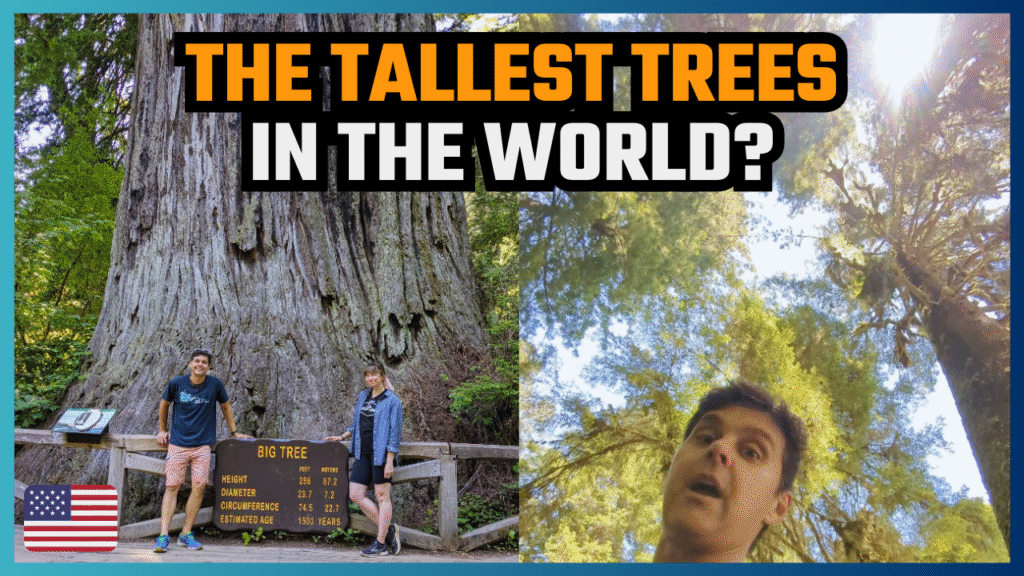
3. The Famous “Big Tree”
You will see signs for the “Big Tree” everywhere. Is it huge? Yes. Does it have a sign with all its stats? Definitely. But here’s a tip from traveler to traveler: don’t waste too much time in the photo line. The park is full of trees just as large or larger than the “Big Tree” on less crowded trails where you can have the giant all to yourself.
4. Short Roadside Trails (The Magical Secret)
Our best experience wasn’t on a famous trail, but in random stops along Highway 101 and smaller parallel roads (like the Newton B. Drury Scenic Parkway). By parking the car and simply stepping into the woods on narrow 1 km or 2 km trails, you feel truly inside the forest. The sound of the creek, the thick moss on the trunks, and the absolute silence create a fairy-tale atmosphere—or a Jurassic Park one, as many of these ferns are species that lived alongside dinosaurs.
Survival Tips and Park Etiquette
To make your trip perfect, a few technical details make all the difference:
- Weather: Even in the summer (we went in July), the temperature under the shade of the Redwoods is cool. I was wearing shorts and a t-shirt, but a light jacket is essential, especially if the coastal fog rolls in.
- Animal Safety: Remember, this is black bear and mountain lion territory. While it’s rare to see them on busy trails, always store your food correctly and stay alert.
- California’s “Bigfoot”: You will see a lot of Bigfoot merchandise in the region. It’s a fun local legend, and the shops in Crescent City and Eureka exploit it to the max. It’s the perfect place to buy a kitschy souvenir.
- Respect the Roots: Redwood roots are shallow (reaching only about 3 meters deep), but they extend up to 15 meters horizontally and intertwine with other trees for stability. Avoid stepping excessively near the base of the trees to prevent soil compaction, which hinders nutrient absorption.
Why These Giants Still Exist
It is sad to think about, but 95% of the original Redwoods were cut down by the logging industry starting in the 1800s. What we see today is just the remaining 5%, protected by law. Visiting the park is a lesson in conservation. By paying your entrance fee and following the rules, you are ensuring that future generations can also feel “small” in the presence of these millennia of life.
Walking among the Redwoods is more than just a tourist outing; it is a spiritual experience. It is a place where time seems to stand still and where nature shows all its strength and delicacy simultaneously.