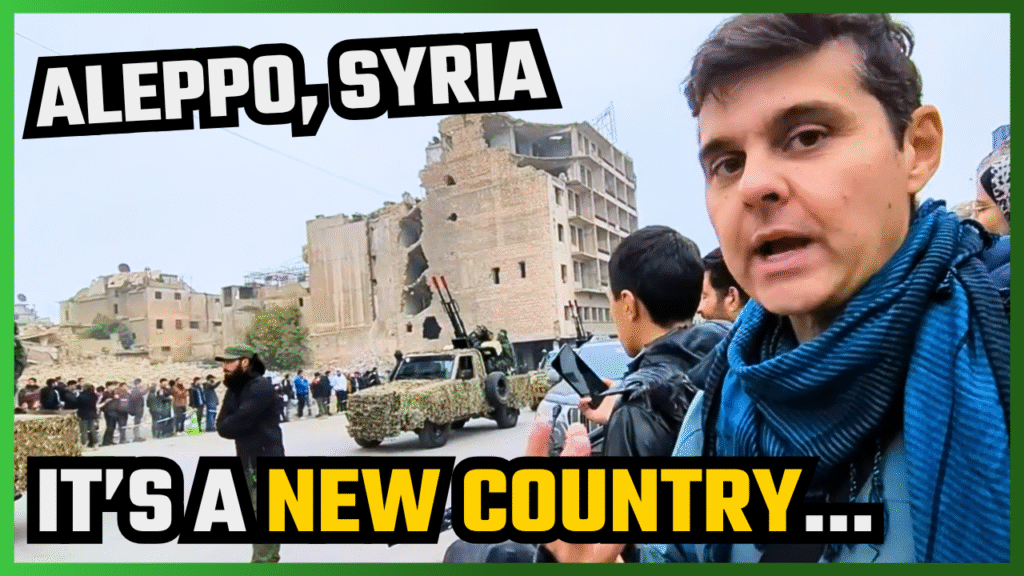
Traveling to places that have just emerged from intense conflict isn’t for everyone, I know. But as a geopolitics enthusiast and someone who lives to understand the world beyond the headlines, I couldn’t miss a historic moment: the first anniversary of the liberation of Syria, specifically in Aleppo, the country’s second-largest city.
The atmosphere I found in the streets was indescribable. Imagine a country that endured 50 years of heavy dictatorship and nearly 14 years of a brutal civil war that cost hundreds of thousands of lives. Now, imagine those same people celebrating one year of a “Free Syria.” The feeling wasn’t just a fleeting joy, like a goal in a World Cup final; it was the euphoria of those who finally feel that the future has begun.
In this article, I’ll share the details of this surreal experience, what I saw at the military parade, the nuances of security, and practical tips for those who, like me, wish to explore destinations that are rebuilding.
Or watch my full video about the first military parede of the New Syria:
The Impact of a Festive Aleppo
Arriving in Aleppo today means seeing the vivid contrast between destruction and hope. On one side, you see buildings in ruins and bomb craters that still scar the asphalt. On the other, giant screens broadcast celebrations from Damascus, entire families are in the streets, and there’s a contagious energy.
What impressed me most was the freedom of expression that seems to be blossoming. I heard reports that, for the first time in decades, people can use social media without fear, mock leaders in memes, and express opinions that would have previously cost them their freedom. Of course, structural issues and problems with minorities still exist—the country won’t become Finland overnight—but the path forward seems to be marked by deep patriotism.
The Military Parade: Weapons, Tech, and Geopolitics
I had the privilege of following the military parade, the first of the free Syria. Thanks to some “special access” (we were recognized by local journalists who had interviewed us days before!), we secured a privileged vantage point near a main roundabout.
The parade was a massive display of force and, for those who enjoy military technology, a fascinating sight. I saw up close:
- Technicals: Those famous pickup trucks with anti-aircraft machine guns mounted in the back, very common in Middle Eastern and African conflicts.
- TOW Anti-Tank Missiles: American-made, used intensely in the early stages of the civil war.
- ** .50 Anti-Material Rifles:** Heavy equipment used to destroy structures and vehicles.
- Drones: Surprisingly, drone technology is already integrated into the local forces. It’s the future of warfare, and seeing this in a country that has barely begun to rebuild is a reality check.
A curious observation I made was regarding mobility. Inspired by what’s happening in the war in Ukraine, they are using fast vehicles and motorcycles. In a scenario where drones are the greatest threat, heavy and slow armored vehicles become easy targets. Trading protection for speed is the new rule of the game.
Security: Did I Feel Safe in Syria?
This is the question I get 100% of the time. And the answer might surprise you: yes, I felt very safe in Aleppo.
While walking through the crowds at night, I noticed tight security control. There were many men armed with Kalashnikovs, snipers positioned on rooftops, and a constant presence of military police. Ironically, the sense of personal security there felt higher than in many areas of Rio de Janeiro, for example.
The Syrian people have immense respect for foreigners. Since we were among the few tourists in Aleppo that day, we were an attraction in our own right. Children shouted “ajnabi” (foreigner), and everyone wanted to take photos.
The Power of the Brazilian Passport
Here’s a valuable tip for my fellow travelers: the Brazilian passport is gold in conflict zones.
Whenever we said we were from Brazil, people’s faces would instantly light up with a wide smile. “Neymar!”, “Futebol!”, “Brazil good!”. Our external brand is extremely positive. We are seen as a friendly, neutral, and joyful people. In places where the relationship with Americans or Europeans might be tense due to political issues, being Brazilian opens doors and provides an extra layer of sympathy and security.
Understanding the Symbols: White and Black Flags
During the celebration, you will see many flags. It’s important to understand what they mean so you don’t jump to conclusions.
- Flag of the New Syria: This represents the current liberation movement.
- Shahada Flags: These are flags with the Islamic declaration of faith written on them.
- White: Often associated with religious purity or, in specific contexts like Afghanistan, the Taliban. Here, it appeared frequently, symbolizing religious conservatism, but in a less aggressive way.
- Black: Generally associated with more extremist movements and combat jihadism. Fortunately, I saw very few of these in Aleppo, which indicates a shift toward a less radical path than in previous times.
If you see someone with a long beard and no mustache, know that this is the visual style of the most conservative or extremist individuals. However, not everyone who follows this aesthetic is dangerous, but for a traveler, maintaining a respectful distance is always the most prudent strategy.
Practical Tips for Traveling to Syria (or similar destinations)
If you’re planning an off-the-beaten-path adventure, here is my golden advice:
- Don’t Underestimate the Crowd: In large celebrations, the masculine energy is very strong and the crowds can be suffocating. If traveling with women, as I was with Nick, stay alert to visual harassment and prefer areas where families are present.
- Beware of “After Sunset”: Although security seemed good, we avoided being on the street after total dark in large crowd areas. Visibility drops and any confusion can escalate quickly.
- Enjoy the Local Cuisine: Syrian shawarma is legendary! And they have the wonderful habit of putting french fries inside the sandwich. It’s simple, cheap, and delicious.
- Respect the Conservatism: Syria is a majority Muslim and very conservative country. Even in the euphoria of the party, there was no alcohol. The energy comes from faith and the celebration of freedom, not substances. Respect this fully.
- Information is Survival: Study the local geopolitics before you go. Understanding who the groups involved are and what each flag represents helps you read the environment and avoid risky situations.
Conclusion: Hope Amidst the Rubble
Witnessing the first anniversary of Syria’s liberation in Aleppo was a lesson in resilience. Despite all the destruction that is still visible, the look in the eyes of the Syrian people is one of hope. They are rebuilding not just buildings, but institutions, an army, and a national identity.
Syria still has a long way to go to become a conventional tourist destination, and political problems are far from over. But being there, sharing a sandwich with locals who hadn’t seen tourists in years and seeing the genuine joy of a free people, makes every risk worth it.
If you have curiosity and respect for history, put Syria on your radar. It’s a country that needs to be seen and heard.