
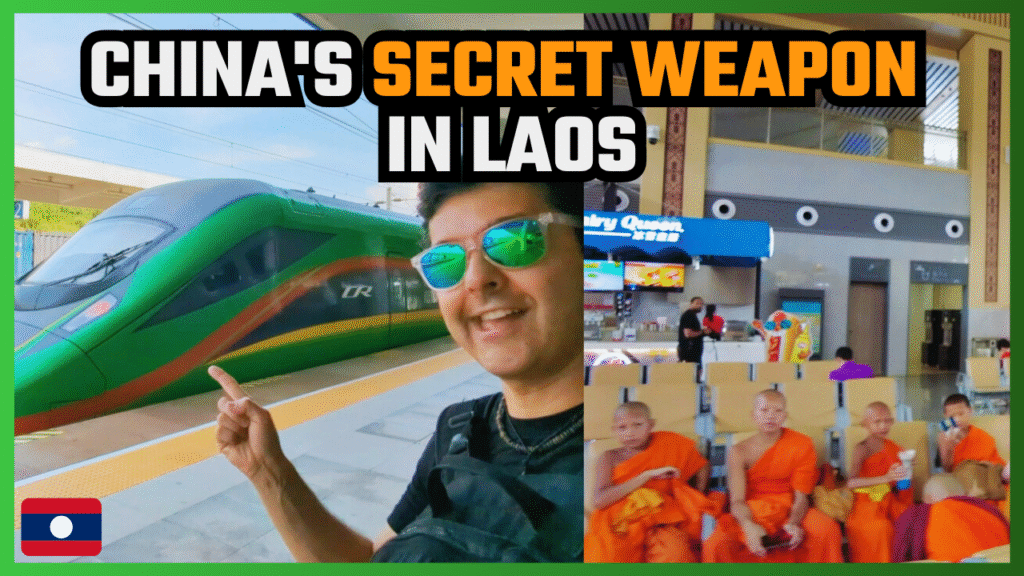
If you are planning a trip to Southeast Asia or backpacking the region, you’ve likely heard of the famous Banana Pancake Trail. This classic route through Thailand, Vietnam, Cambodia, and Laos just received a high-tech upgrade that has completely changed the game: the high-speed train funded by China.
Recently, I had the opportunity to embark on this journey starting from Luang Prabang, and I can tell you: it is much more than just a means of transport. It is a deep dive into one of the most ambitious geopolitical strategies of the 21st century. In this article, I’ll tell you everything about the experience, how to buy tickets, and why this railway is the talk of the town in Laos.
Or watch my full experience on Youtube:
What is the Chinese Train in Laos?
Officially called the Boten–Vientiane Railway, this pharaonic project is part of the Chinese Belt and Road Initiative (the New Silk Road). The idea is to connect southern China directly to Singapore, crossing Laos from north to south.
For a mountainous, landlocked country like Laos, this is a revolution. Previously, to get from Luang Prabang to Vang Vieng or the capital, Vientiane, you would face hours in cramped vans on roads full of potholes and winding curves. Now, what used to take 5 or 6 hours by road is done in just 1.5 hours in total comfort.
Geopolitical Insight: Pay attention to the size of the stations. They are gigantic, disproportionate to the cities where they are located. This shows China’s intention to gain influence in the region, creating an infrastructure dependency that often generates debts that are difficult for smaller countries to repay. This is what we call the “debt trap,” something to reflect on while you enjoy the landscape.
How to Buy Train Tickets in Laos
This is the part that usually raises the most questions for travelers. There are basically three ways to secure your seat:
- Official App (LCR Ticket): This is the cheapest way. You download the app on your phone, register, and pay the official price. However, the system can sometimes be unstable for foreign credit cards.
- Third-Party Agencies (Like 12Go Asia): This is the most practical option for those who want to avoid headaches. They charge a small service fee but guarantee the ticket and often deliver the QR code directly to your WhatsApp or email.
- At the Station: You can buy in person, but I don’t recommend leaving it until the last minute. Trains tend to fill up quickly, especially with the large influx of Chinese tourists who now have easy access to Laos.
Pro Tip: The Luang Prabang station is about 20 to 25 minutes from the city center. Since there is no Grab (the Uber of Southeast Asia) in Laos, you will have to negotiate with tuk-tuk drivers. Expect to pay around 40,000 to 50,000 Kip for the ride.
The Onboard Experience: What to Expect
Upon entering the station, prepare for rigorous security screening, airport-style. No pocket knives or flammable sprays in your carry-on!
Comfort and Infrastructure
The train is impeccable. Clean, modern, and with powerful air conditioning (a relief in the humid heat of Laos). The second-class seats (where I traveled) are spacious, have outlets to charge your phone or laptop, and fold-down tables—perfect for someone like me who needs to work while traveling.
If you want a bit more luxury, first class offers seats that recline almost fully and even more legroom. But honestly? Second class is already better than many international flights out there.
Food and Drink
Inside the station, you’ll find options like Dairy Queen and local cafes (such as Café Amazon, which has excellent Wi-Fi, a rarity at the stations). Inside the train, there is a dining car and attendants who walk through selling snacks.
Golden Tip: Bring your own water bottle. On the train, they only offer hot water (for the Chinese passengers’ tea). If you want cold water, you’ll have to buy it at the kiosks before boarding.
The Curious Side: Buffaloes and Containers
One of the most emblematic scenes of this trip is looking out the window and seeing water buffaloes grazing peacefully next to an ultra-tech railway line. It is the clash between traditional, rural Laos and the modernity imposed by China.
Furthermore, you will see many freight trains passing by. The railway is not just for tourists; it is China’s main export artery to Southeast Asia. By facilitating the transport of goods to the port of Singapore, China manages to bypass strategic naval blockades in the Pacific, which is a geopolitical checkmate against the United States.
Is it Worth it?
Absolutely! I paid about 10 dollars for a fast, safe, and comfortable trip. Seeing the landscape of Laos—full of mountains and endless tunnels—through the window of a high-speed train is an experience I highly recommend to every traveler.
It completely changes the logistics of your trip. You gain time to enjoy the waterfalls of Luang Prabang or the blue lagoons of Vang Vieng, instead of wasting the whole day feeling car-sick inside a van.
My conclusion: The train in Laos is a fascinating example of how infrastructure can transform a country while simultaneously serving as a powerful tool for soft power. If you are in Southeast Asia, don’t miss the chance to see this up close.