When we think of traveling to Southeast Asia, images of golden temples, endless rice paddies, and paradise beaches are usually the first to come to mind. However, my latest journey through Laos led me to face a much deeper and, honestly, shocking reality. Did you know that, technically, Laos holds the tragic title of the most heavily bombed country per capita in history?
In this article, I want to take you with me to understand what the “Secret War” was and how UXOs (Unexploded Ordnance) still shape the lives, economy, and safety of the Lao people decades after the conflict ended. If you plan to visit this incredible country, understanding this part of its history is not just an option—it is a duty for every conscious traveler.
Or watch my full experience on Youtube:
The History the World Forgot: The Secret War in Laos
To understand the Laos of today, we must go back to the 1960s and 70s during the Vietnam War. While the world’s attention was fixed on its neighbor, the United States was carrying out a massive and clandestine operation in Laos. The goal was to cut off the Ho Chi Minh Trail, a vital supply route that crossed through Lao territory to support North Vietnamese troops.
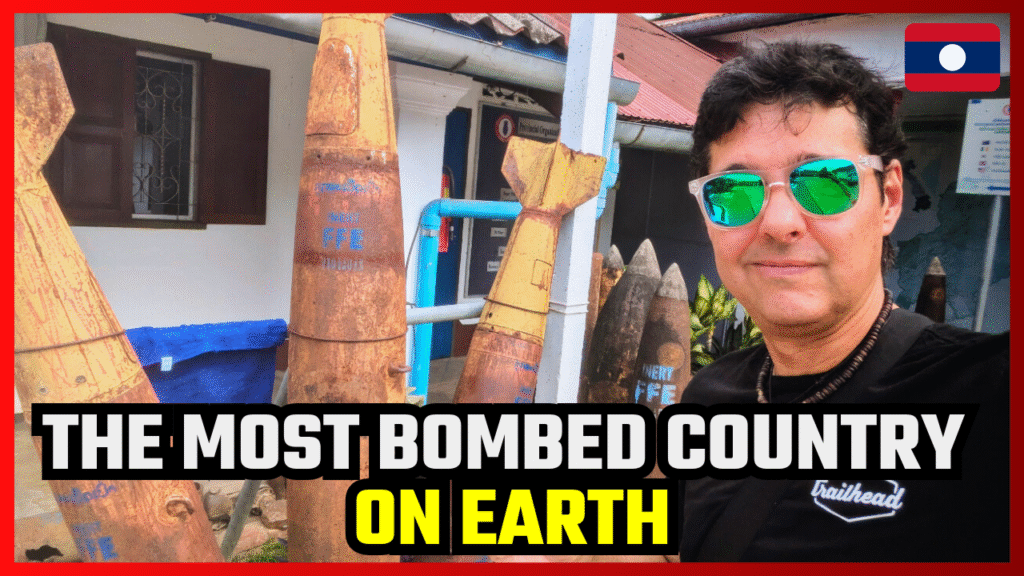
The numbers are staggering: approximately 2 million tons of bombs were dropped on the country between 1964 and 1973. This is equivalent to a planeload of bombs being dropped every 8 minutes, 24 hours a day, for 9 consecutive years. The most tragic part? About 30% of these bombs—known as “bombies” (cluster munitions)—failed to explode on impact. They remained there, hidden in the earth, waiting.
The Invisible Danger of UXOs (Unexploded Ordnance)
While walking through the rural areas of Laos, the beauty of the mountains hides a lethal danger. UXOs are munitions that failed to detonate and remain active beneath the surface. During my travels, I realized that what looks like a random piece of rusted metal can actually be a deadly weapon.
These bombs continue to kill and maim people to this day. Farmers trying to plow their land, children who mistake the small metal spheres for toys, and people searching for scrap metal to sell are the primary victims. It is a war that never ended for the people of Laos.
The COPE Center in Vientiane: Where Pain Meets Hope
A mandatory stop on any itinerary through Laos is the COPE Center (Cooperative Orthotic & Prosthetic Enterprise) in the capital, Vientiane. Visiting this place was one of the most moving experiences of my life.
COPE is an organization that provides prosthetics and rehabilitation for survivors of bomb explosions. There, you see human resilience firsthand. The center’s museum displays hundreds of old, handmade prosthetics made of wood or improvised metal, highlighting the precariousness these people had to deal with for years. It is a necessary reality check for any tourist.
“War Architecture”: Turning Bombs into Decor
Something I found fascinating (and a bit disturbing) was seeing how the Lao people integrated war remnants into their daily lives. In several villages, especially near the Plain of Jars or in Phonsavan, it is common to see:
- Houses built on pillars made of large bomb casings.
- Flower pots and fences made from scrap ammunition metal.
- Restaurants decorated with missile shells.
This “upcycling” isn’t just about aesthetics or tourism; it’s a form of pragmatism. Metal was abundant and free in a land devastated by poverty. Seeing a garden bloom inside an object designed for destruction is the perfect metaphor for modern Laos.
Essential Tips for Travelers in Laos
If you are planning your trip, here are some practical recommendations to navigate this context safely and respectfully:
1. Never stray from marked trails
This is rule number one. In provinces like Xieng Khouang and Luang Namtha, the risk of finding active bombs is real. If you see signs for “MAG” (Mines Advisory Group) or danger placards, take them very seriously. The work of clearing these lands is slow and is expected to take several more decades.
2. Support local organizations
When visiting the COPE Center in Vientiane or the MAG centers, consider making a donation or buying something at the gift shop. The proceeds from these sales go directly toward funding prosthetics and the team of specialists who deactivate bombs every day.
3. Visit the UXO Information Center in Luang Prabang
While Luang Prabang is famous for its colonial charm and temples, it also houses a small but excellent UXO information center. It is a great place to watch short documentaries explaining the logistics of demining.
4. Be sensitive when taking photos
Remember that to us, bomb casings might look “exotic” or “curious,” but for local families, they represent deep trauma. Ask for permission before photographing objects on private property and show respect for the history that object carries.
Geopolitics and Responsibility: The Role of the US
It is impossible to discuss this topic without mentioning political responsibility. For a long time, the US denied the extent of the bombings in Laos. It has only been in recent years that the American government has significantly increased funding for mine removal.
As travelers, understanding these invisible threads of geopolitics makes us more than just observers; we become witnesses. Laos is a country that holds no grudge against Westerners—which is surprising given its history—and the hospitality of its people is something you will never forget.
Conclusion: Why learn about this side of Laos?
Traveling to Laos and ignoring UXOs would be like visiting Rome and ignoring the Colosseum—you would be missing the essence of the national identity. Laos is a living example of overcoming adversity. By visiting rehabilitation centers, talking to locals, and seeing the Herculean effort to clear the land, we realize that tourism can indeed be a tool for education and change.
Laos will win you over through its food, its landscapes, and its spirituality, but it will transform you through its story of survival. The next time you see a sculpture made of bomb metal in a café in Luang Prabang, you will know that it isn’t just decoration; it is a cry of “never again.”