When I first thought about embarking on a journey to the Western Pacific, I must admit anxiety took over. Saipan, the largest island of the Northern Mariana Islands—an overseas territory of the United States—had always been on my radar for legendary travel. Getting there is no task for the faint of heart: it took six flights over two and a half days of intense travel, leaving the continental United States and passing through Vancouver, Hong Kong, Manila, and Guam, before finally landing on this patch of land surrounded by crystal-clear turquoise waters.
To make the adventure even more iconic, I landed on the island just a few weeks after the passage of the devastating Super Typhoon Yagi. Many might have canceled the trip, but the desire to explore one of the most impressive battlegrounds of World War II and to understand the complex geopolitics of the Pacific spoke louder.
In this comprehensive guide, I will share my impressions, historical itineraries, hidden beaches, and all the essential tips for you to plan an unforgettable expedition to Saipan.
Or watch my full experience:
The Enigma of Abandoned Casinos and Saipan’s Urban Landscape
As soon as we started driving around the island, the first major surprise was not a natural landscape, but rather the architectural contrast of colossal, entirely abandoned developments. The most striking example is a former luxury casino complex right in the urban center.
Featuring gold-plated details, golden dolphin statues, and even rusted, stripped-down limousines in the parking lot, the place looks straight out of a post-apocalyptic movie set. Before the global health crisis, Saipan was a bustling gaming and betting destination that attracted thousands of tourists from China, South Korea, and Japan. The pandemic disrupted operations and investments, leaving behind these ornamented concrete giants that seem frozen in time.
Coupled with the recent typhoon, the initial landscape blends the resilience of locals cleaning up the streets with memories of a recent tourism peak. It creates a unique atmosphere that immediately captivates anyone who appreciates off-the-beaten-path urban exploration.
World War II Memories: Bunkers and Historical Relics
The true purpose of visiting Saipan is to immerse oneself in its deep history. In June 1944, the island served as the stage for the bloody Battle of Saipan, a crucial turning point in the Pacific War. Capturing the island allowed Allied forces to launch direct long-range bomber raids against the Japanese mainland.
The great advantage for history enthusiasts is that the scars of the conflict remain fully visible across the island. Literally upon stepping out of the airport, you can already spot concrete fortifications and Japanese bunkers perfectly preserved right next to the runway.
1. The Last Command Post
Located at the northern tip of Saipan, this fortified complex built into natural rock served as the final stronghold for the forces of the Empire of Japan during the Allied invasion. Walking between thick concrete walls with openings strategically engineered for cannons and machine guns feels like traveling back in time. Around the monument, authentic artillery pieces and combat tanks remain exposed in the open air, surrounded by tropical vegetation.
2. Suicide Cliff and Banzai Cliff
Visiting these two cliffs is a deeply moving and solemn experience. Toward the end of the battle, facing imminent defeat, thousands of Japanese soldiers and civilians jumped from these massive rock formations into the abyss or the ocean to avoid capture. Today, the site houses various memorials, shrines, and peace offerings left behind by families and visitors from around the world. The view of the ocean from above is breathtaking, yet the silence of the area carries the immense weight of history.
Paradise Beaches and Submerged War Tanks
Saipan is not only defined by war scars. The archipelago features spectacular tropical beaches where pale sand meets incredibly clear water in vibrant shades of blue.
Tanapag Beach and the Search for Sunken Tanks
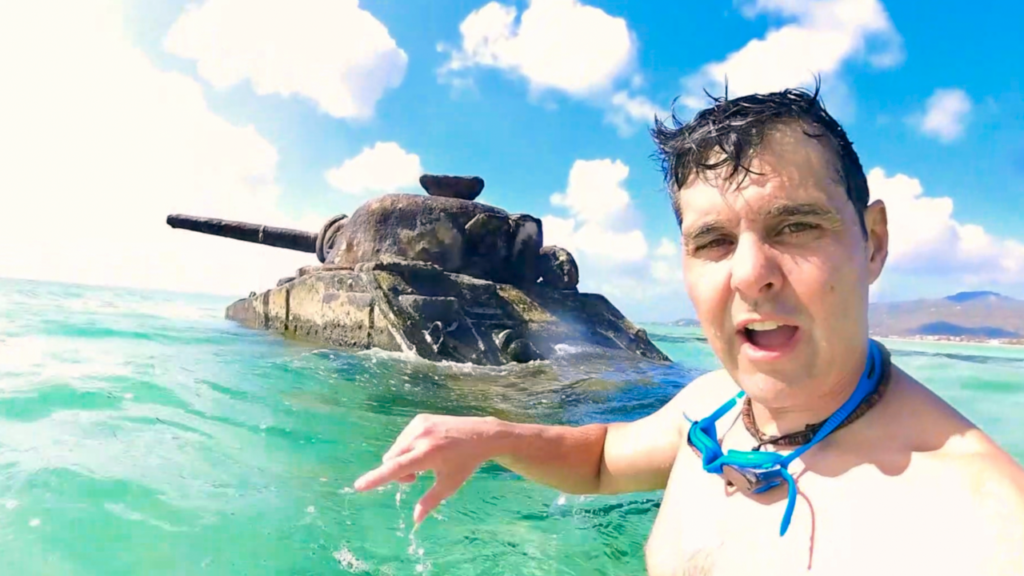
Tanapag Beach is famous not only for its tranquility and deserted shoreline, but also for housing submerged Japanese and American tanks within its shallow lagoon. During low tide, it is possible to swim or wade through coral formations to reach the metallic hulls now embraced by marine life. Snorkeling alongside a Sherman tank covered in coral and tropical fish is a surreal experience.
Golden Tip: Stay alert regarding community dogs along more remote stretches of beach. On several Pacific islands, dogs can be territorial, so maintain a safe distance when walking through completely isolated areas.
Surprising Natural Wonders: Bird Island and The Grotto
Heading toward the north of Saipan, the island’s geography rewards travelers with unique viewpoints and geological formations.
- Bird Island Lookout: One of the most photogenic spots on the trip. From an elevated viewpoint, you can observe a small rocky islet sitting in the middle of a turquoise bay. The color variations in the water are stunning, and with a little patience, it is easy to spot sea turtles swimming freely near the surface.
- The Grotto: One of the island’s most famous attractions for divers. It is a marine sinkhole filled with deep blue water, connected to the open ocean via underwater caverns. Access is made down a steep set of stone stairs. Even if land access happens to be restricted for maintenance or due to weather conditions, it is well worth adding to your itinerary to admire the raw power of local nature.
Saipan’s Geopolitical Status: Understanding the Territory
For those who enjoy understanding the geopolitical context of the places they visit, Saipan provides a practical lesson in political geography:
- Commonwealth of the Northern Mariana Islands (CNMI): It is an unincorporated territory of the United States. Anyone born on the island holds American citizenship and a US passport, but the local population does not vote in US presidential elections and has no voting representation in the US Congress.
- Strategic Importance: Along with the neighboring island of Guam, the Marianas represent key military defense and projection assets for the United States in the Pacific, maintaining essential operational facilities close to East Asia.
Practical Tips for Planning Your Trip to Saipan
To ensure your journey runs smoothly without unexpected hitches, I have gathered the best guidelines based on my on-the-ground experience:
- Documentation and Visa: Since it is a United States territory, entry requirements follow standard US immigration rules. You will need a valid US visa or ESTA (if eligible) to land at the local airport.
- How to Get There: The most common routes pass through hubs in Asia or the Pacific. Connections via Manila (Philippines), Tokyo (Japan), or Seoul (South Korea) with a final flight out of Guam are usually the most efficient options.
- Car Rental: Renting a vehicle upon arrival is practically essential. The island lacks a comprehensive public transportation system, and having your own car ensures full flexibility to explore memorials, beaches, and caves at your own pace.
- Post-Weather Infrastructure: The local government’s response capacity to clear roads and restore essential services after tropical storms is quite swift. However, it is wise to double-check whether state parks and natural attractions are open if there are reports of recent typhoons in the region.
- Respect for Historical Sites: Maintain utmost respect when visiting bunkers, memorials, and cliffs. Never remove pieces of historical structures or war artifacts found in nature.
Final Thoughts
Visiting Saipan means immersing yourself in the untouched beauty of Oceania alongside the dramatic historical events that shaped the modern world. Whether swimming off pristine beaches, exploring abandoned WWII bunkers, or admiring the incredible blue tones of the Pacific, the island delivers an unforgettable experience for travelers seeking authentic destinations filled with meaning.