
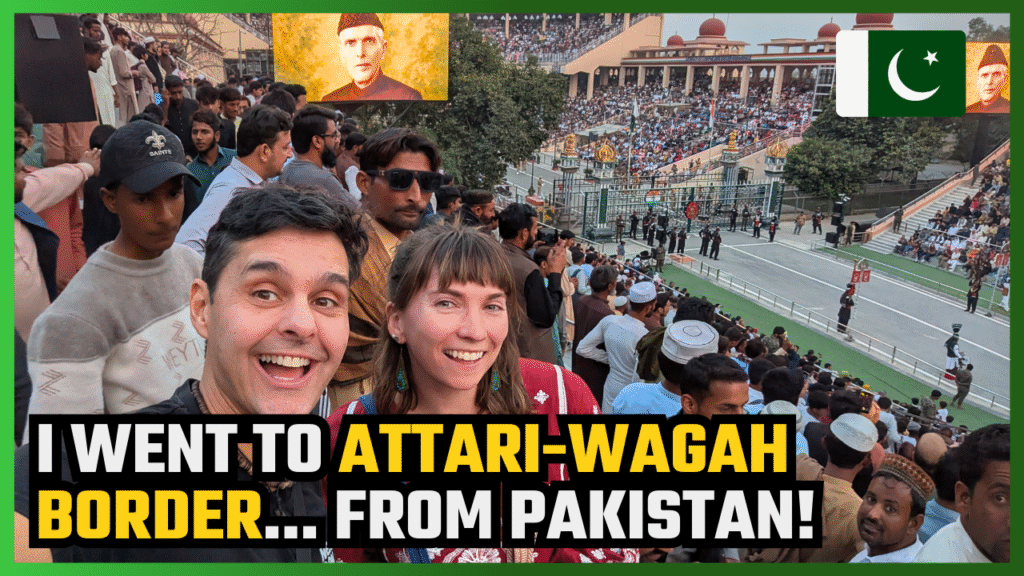
There are travel experiences that completely shatter your perception of the world, and visiting the border between India and Pakistan is, without a doubt, one of them. Imagine a packed stadium, booming music, massive flags, and a military rivalry that feels like high-stakes theater—all set against a backdrop of nuclear weapons and decades of real-world conflict. It is often described as the “Super Bowl of Geopolitics,” and I had the privilege of witnessing this ceremony firsthand from the Pakistani side.
In this article, I’ll take you through the experience of visiting the Wagah Border (Pakistan side), why this ceremony continues even after recent border skirmishes, and how you can plan your visit safely and affordably. Or watch my full video about the ceremony:
What is the Wagah-Attari Border Ceremony?
The ceremony takes place at the only land border crossing between Lahore (Pakistan) and Amritsar (India). It symbolizes the 1947 Partition, when British India was divided into two independent nations: India, which is majority Hindu, and Pakistan, which is majority Muslim.
Since then, the two countries have maintained an intense rivalry. Yet, every day before sunset, the gates open for an impressive military choreography known as the “Beating Retreat.” It is a display of pure nationalism, where soldiers in ceremonial dress and fan-shaped headgear perform rapid marches and high kicks—a sort of “intimidation dance” that remains strangely friendly.
Getting There: The Local “Hop-on Hop-off” Trick
While you can go independently using public transport and tuk-tuks, my partner Nick and I decided to use the Lahore Hop-on Hop-off bus. Usually, these tourist buses in Europe aren’t very “authentic,” but in Pakistan, it’s a different story: the locals actually use this service for their own excursions.
The tour cost about $3 more than standard transport, but it was worth every cent. Not only did we have a guide explaining the historical context, but the bus also dropped us off right at the stadium gates, saving us a long walk in the scorching sun. The service is backed by the Punjab Tourism Development Corporation, so you know the money is supporting local infrastructure.
The “Home Side” Experience: Pakistani Patriotism
Arriving at the Wagah Border feels like arriving at a World Cup final. The stadium on the Pakistani side was vibrating with national songs and chants. Interestingly, just across the gate, the Indian stadium was equally packed. It’s a literal shouting match: who can cheer louder for their country?
The patriotism is palpable. We saw massive Pakistani flags trying to tower over the Indian flags on the other side. It’s a rivalry that, at the grassroots level, feels more like a “wounded brotherhood” than blind hatred. Many Pakistanis I spoke with view Indians as “brothers and sisters” separated by politics.
The Nuclear Context and Recent Tensions
Don’t let the festive atmosphere fool you; the tension is real. Just five months before my visit (in May 2025), there was a heavy conflict between the two nations involving downed fighter jets and missile launches. Because of this, I noticed the ceremony was slightly different: the gates remained closed, and the guards did not shake hands—a gesture that usually happens during times of relative peace.
Another striking security detail: there is no cell service or internet at the border. This is a signal-jamming measure to prevent the remote detonation of explosive devices. It is a constant reminder that you are standing in one of the most monitored and sensitive places on Earth.
Being a “Celebrity” for a Day
If you want to know what it feels like to be a celebrity, visit Pakistan. Since there aren’t many foreign tourists, Nick and I were constantly surrounded by people wanting photos. Sometimes it gets overwhelming—especially for women, as some crowds can be a bit pushy—but mostly it’s pure warmth and curiosity.
One little girl took a photo with Nick and said, “You made me very happy today.” Those human connections make any bureaucracy or heatwave worth it.
Practical Tips for Travelers
- Timing: The ceremony starts around 4:30 PM, but the time changes with the sunset. Arrive early to clear security.
- Security: Men and women stand in separate lines. Be prepared for rigorous pat-downs.
- What to bring: Only the essentials. Avoid large backpacks. Bring water, as the Punjab heat can be relentless.
- Respect: Follow the instructions of the Rangers (the Pakistani paramilitary). When they tell the crowd to sit, sit.
Conclusion: Is It Worth It?
Watching the Wagah Border ceremony is like watching history being written in real-time. It’s a spectacle that blends military aggression with a latent desire for peace between two peoples who share the same roots. If you are in Lahore, this is a non-negotiable stop. It is the world’s most intense stadium show, where the only thing that truly explodes is the energy of the crowd.