
Traveling to Afghanistan is, in itself, a challenge that demands courage and an open mind. But when the destination is Kandahar, the experience reaches an entirely different level. Known as the spiritual birthplace of the Taliban, this city is often described as the most conservative place on the planet.
Recently, my wife Nikki and I decided to explore this territory where time seems to have frozen. What we found was a dense mixture of war scars, curious hospitality, and a social reality that shocks any Westerner: the near-complete invisibility of women in public spaces. In this article, I share the details of this deep immersion and provide crucial tips for anyone (for some fascinating reason) wishing to add Afghanistan to their travel map.
Or watch our full video about Kandahar:
The Visible Scars of Civil War
As soon as you walk through the central streets of Kandahar, the country’s violent past jumps out at you. I’m not just talking about the 2001 American intervention, but the deep marks of the civil war that preceded it.
I spotted entire buildings whose facades are literal “sieves” of bullet holes. It’s an apocalyptic setting that serves as a constant reminder that, before the international coalition, the country was already devastated by internal struggles between the Taliban and the Mujahideen. Seeing these marks in person helps one understand why peace, even under a rigid regime, is valued by part of the local population.
The Experience of Being Surrounded by Locals
One of the most intense sensations of traveling through Afghanistan is the constant interest you spark. In Kandahar, we were surrounded several times by groups of young men and children. In the West, if a group of ten men surrounds you on the street, the immediate instinct is danger. Here, however, most of the time, the motive is pure curiosity.
They want to know where you are from (Brazil is always a friendly icebreaker), what you are doing there, and, of course, they want to be in a photo. However, caution is necessary. Especially with large groups of street children, the situation can escalate quickly. At one point during our tour, children began throwing stones and sticks—a “toddler revolution” that forced us to grip our belongings tightly and pick up the pace. My security tip? Keep your phone and camera protected at all times and avoid large crowds of unaccompanied minors.
Flavors of Kandahar: Pomegranate Juice and Local Cuisine
Despite the austere environment, Kandahar offers unforgettable flavors. The city is famous for its pomegranate production, considered among the best in the world. Drinking fresh pomegranate juice, made on the spot by the roadside, is mandatory. It’s a burst of antioxidants and natural sweetness that helps ease the day’s tension.
For dinner, we went to a restaurant considered “fancy” by local standards. In Afghanistan, the electrical infrastructure is precarious, and the city plunges into total darkness at night. Elite restaurants rely on their own generators.
A cultural curiosity: these places have reserved areas for families, separated by curtains. It is the only time women can perhaps show their faces and eat with a bit more privacy. In the main hall, however, the scene is always the same: 100% men.
The Mausoleum of Ahmad Shah Durrani and Afghan History
We visited the sacred Mausoleum of Ahmad Shah Durrani, the founder of modern Afghanistan. It is a place of impressive architectural beauty, with mosaics and tiles that contrast with the dust of the streets.
We managed to enter thanks to the help of a local who had worked with American engineers and spoke fluent English. He facilitated our entry with the Taliban since we didn’t have the specific local permit at that moment. This type of spontaneous help is common, but remember: in Afghanistan, rules about what can or cannot be filmed change according to the mood of the authorities. Military buildings and checkpoints are strictly off-limits for cameras.
Anti-Blast Walls: The Architecture of Insecurity
Something that defines the urban landscape of Afghan cities are the “T-walls.” These are giant pre-cast concrete blocks designed to contain the impact of car bomb explosions. In Kandahar, they are everywhere: surrounding hotels, police stations, and government buildings. It is an architecture of fear that has become part of daily life. Even with the reduction in bombings after the Taliban’s return to power, these walls remain as scars of an era of constant terrorism.
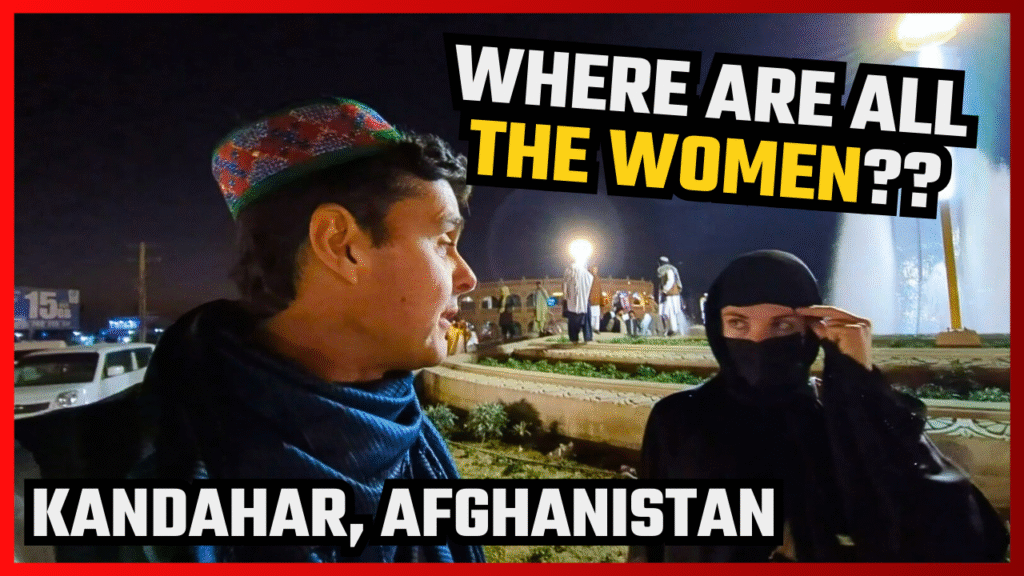
The Mystery of Friday Night: Where Are the Women?
Friday is the holy day of Islam, the equivalent of our Sunday rest. We decided to explore the area of Aino Mina, an elite neighborhood in Kandahar, with illuminated fountains, modern hotels, and well-kept squares.
The experience was surreal. Thousands of men were on the streets, chatting, eating ice cream, and riding motorcycles. But as I looked around, I noticed something shocking: there were no women. Literally, Nikki was the only visible woman in miles of social area.
It is complete social exclusion. While men enjoy evening leisure, women remain confined to their homes. In other cities, like Kabul or Bamyan (where the Hazara ethnicity is predominant), the female presence is much higher. But in Kandahar, Pashtun conservatism is absolute. It is an environment charged with testosterone where female freedom simply does not exist in the public space.
Is Kandahar Worth Visiting?
Kandahar is not a destination for a relaxing vacation. It is a trip of study, cultural shock, and geopolitical understanding.
Tips for those planning to go:
- Permits: You will need a national permit to travel through the country, but be prepared for local bureaucracies in each province.
- Dress Code: Men should wear the Shalwar Kameez (traditional clothing) to blend in. Women must wear a full hijab and, in Kandahar, clothing that does not draw attention.
- Respect the Rules: The Taliban can be unpredictable. We were ignored by them most of the time because we were dressed traditionally, but never challenge a direct order from them.
Kandahar showed us that Afghanistan is not a monolith. Every city has its own level of rigor. However, leaving there left us with a sense of privilege and melancholy. Seeing a place so beautiful and historically rich be so restrictive to half of its population is a lesson in humanity that no comfort zone can teach.