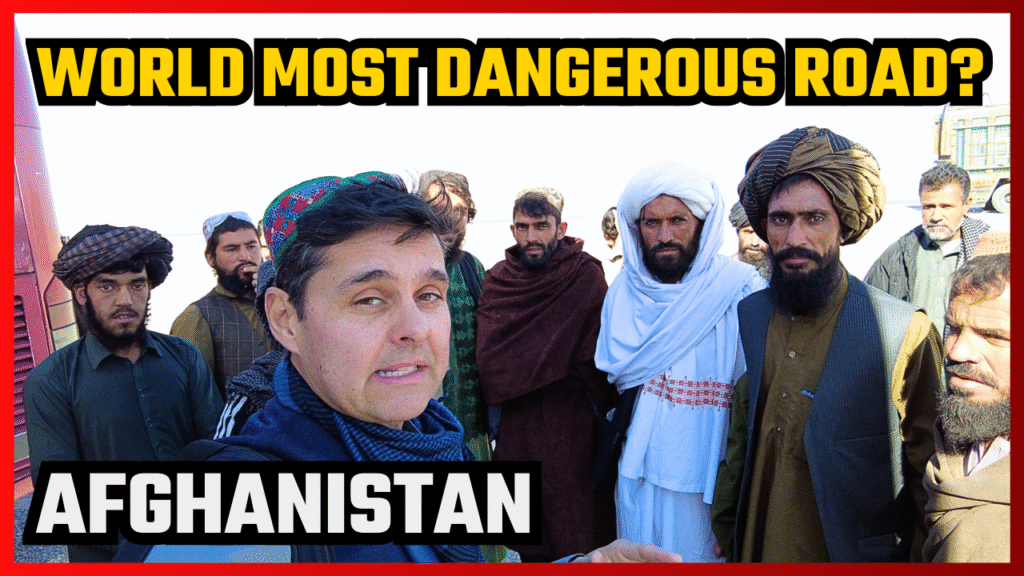
Traveling through Afghanistan is, by definition, stepping out of your comfort zone. But there is one specific stretch that makes even the most experienced traveler take a deep breath: the road connecting Herat to Kandahar. We are talking about crossing the provinces of Helmand and Kandahar—regions that, for decades, were the epicenter of conflict and are considered the birthplace of the Taliban.
If you are planning a trip to Afghanistan or are simply curious about what life is like behind the headlines, follow my first-hand account of 10 hours on a VIP bus crossing the Afghan desert. Or watch our full video about travelling Afghanistan by bus:
The Departure: Organized Chaos in Herat
Our journey began early in Herat. If you’ve read my post about the city, you know that buying a bus ticket here isn’t like going to a website and clicking “book.” It’s a mess. The “station” is actually a cluster of buses and ticket shops where shouting is the rule.
We paid about 12 dollars per person for what they call a “VIP Bus.” It might seem expensive by local standards, but the safety and comfort are worth every penny.
Pro Tip: In Afghanistan, logistics are based on trust. We left our large suitcases in the lower luggage compartment and went up only with the essentials (laptop, money, and passports). It’s an exercise in letting go, but the local hospitality is surprising.
Life Inside an Afghan VIP Bus
Upon entering the bus, the first surprise: you must take off your shoes. They hand you a plastic bag to store your footwear. The interior is fully carpeted, creating a strange sensation of a moving “living room.”
Nikki (my wife and adventure partner) and I were placed in the front seats. I noticed something important: the bus was packed with men. Nikki was the only visible woman. In Afghanistan, social norms are strict, especially in conservative regions like the South. She traveled covered, and at many checkpoints, the authorities barely noticed her presence, focusing only on me.
Geopolitics Through the Window: War Scars and Foreign Influence
As we left Herat, the landscape began to reveal layers of recent history. We passed abandoned military bases and museums like the Jihad Museum. A fascinating point I observed was the presence of Indian flags on some infrastructure.
India has invested heavily in Afghanistan as a strategic maneuver to surround Pakistan. It’s real-world geopolitics happening right before our eyes: investments that, while politically motivated, end up improving basic infrastructure for the Afghan people.
The roads, in fact, are surprisingly good in many stretches. This is a legacy of the trillions of dollars invested by the international coalition (led by the US) during the 20-year occupation. Anyone who says nothing was built during that period clearly hasn’t crossed the country by land.
Crossing Helmand: The Desert and Military Bases
Helmand province is vast and desertic. It’s a landscape reminiscent of Tatooine from Star Wars. But the natural beauty hides a dark past. We crossed massive bases, such as the former Camp Shorabak airbase, which housed US Marines and British troops.
Seeing those immense structures now silent, surrounded by dirt berms and abandoned antennas, brings a profound reflection on the ephemerality of military power.
A positive note: the country is being “saved” by cheap Chinese solar panels. Since much of Afghanistan lacks a reliable power grid, the desert sun has become the primary energy source for isolated communities.
Unusual Interactions: Tea with the Taliban?
Many people ask me about safety. During a rest stop in the middle of the desert, I was approached by a few men. I discovered that two of them were Taliban members. My initial reaction was one of alertness, but the interaction was the opposite of what one might imagine.
They were extremely cordial. One of them even bought a drink for Nikki and me. “If you have any problems, talk to us. We want tourists to feel safe,” they said. It’s a clear strategy by the new government to change the country’s international image. I even got a discreet selfie request from one of them.
Important Note: As a Christian and a foreigner, I didn’t need to get off for prayers, but in regions like Kandahar, it is respectful (and safer) to follow the social flow so as not to be seen as an outsider.
The Challenge of Arriving in Kandahar
The plan was to arrive during the day, but the “Tetris” of Afghan traffic and multiple prayer and checkpoint stops turned the trip into a 10-hour ordeal. We arrived in Kandahar at 8:00 PM in total darkness.
Kandahar is the spiritual and political heart of the Taliban. Arriving at night as a foreigner generates natural stress. We were surrounded by aggressive taxi drivers at the station.
Fortunately, we befriended a gentleman on the bus. He noticed our vulnerability and put us in his taxi. He went 20 minutes out of his own way just to ensure we reached our hotel safely. And the most incredible part: he flatly refused any payment. “You are my guest in Afghanistan,” he said via Google Translate.
Where to Stay and What to Eat in Kandahar
Finally at the hotel, the reward was a traditional dinner: Biryani and Kebab. After 12 hours without a solid meal, that flavor was unforgettable.
We stayed in a traditional-style room, with cushions on the floor and decor reminiscent of local palaces. It’s a fascinating contrast to the chaos of the streets. Kandahar is more conservative than Kabul or Herat, and this is reflected in everything from clothing to the way people interact.
Conclusion: Is it Worth it?
Crossing southern Afghanistan is not for everyone. It is tiring, psychologically demanding, and requires a deep respect for the local culture. However, it is the only way to understand the complexity of this country. Afghan hospitality is not a myth; it has survived decades of war and remains the most striking trait of its people.