Traveling through Afghanistan is, without a doubt, one of the greatest challenges I’ve ever faced. But standing in Bamiyan, walking before the empty niches where the world’s largest Buddha statues once rested, is one of those experiences that fundamentally shifts your perspective on time and politics.
If you, like me, are passionate about destinations that go off the beaten path and carry deep layers of history and geopolitics, join me as I explore the ruins of Bamiyan and the haunting “City of Screams.” Watch my full video about visiting the Buddhas of Bamian:
Bamiyan: A Historical Refuge in the Heart of Afghanistan
Arriving in Bamiyan, at about 2,500 meters (8,200 feet) above sea level, literally takes your breath away. The city is visually stunning, reminiscent of movie sets like Star Wars (anyone who has visited Tunisia will feel the similarity). However, what truly dominates the landscape are the massive stone cliffs riddled with caves that served as homes for Buddhist monks centuries ago.
The Buddhas of Bamiyan and the Scars of 2001
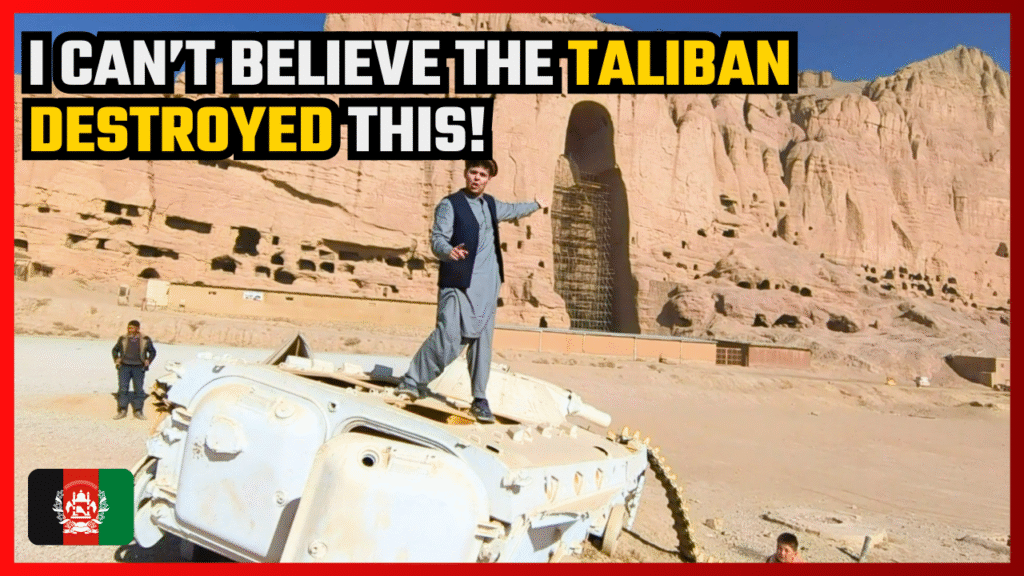
Visiting the site where the Buddhas once stood is an exercise in melancholy. Destroyed by the Taliban in March 2001, just months before 9/11, what remains are stone fragments that look like an impossible puzzle.
We climbed the internal staircases—tunnels carved inside the mountain itself—to reach what would have been the Buddha’s head. The view from the top is privileged, but the irony is palpable: today, the very group that destroyed these archaeological treasures is the one guarding them and charging tourists for admission.
Shahr-e Gholghola: The City of Screams
Further ahead, we visited the citadel of Shahr-e Gholghola, or the “City of Screams.” The terrifying name comes from the massacre committed by Genghis Khan and his Mongol army in the 13th century, who exterminated the local population.
Walking through these Islamic ruins on the Silk Road, currently supported by UNESCO for preservation, is fascinating. The place is virtually empty; it was just us, our guide Azim, and the omnipresent Taliban guards. This is a destination that, in any other country, would be swarming with tourists, but here it offers a reflective silence.
Geopolitics in Real-Time: War Scars and Soviet Armor
Afghanistan doesn’t let you forget its bellicose past. On the roads heading back to Kabul, the scars are visible:
- Soviet Armored Vehicles: The carcasses of Soviet BTRs from the 1979 invasion decorate city entrances like war trophies.
- Cratered Roads: Many stretches of the road were destroyed not by time, but by IEDs (Improvised Explosive Devices) used against international coalition convoys.
- American Heritage: We saw several Humvees and trucks left behind by the Americans, now integrated into the current government’s fleet.
Normal Life in Kabul?
To end the journey, we returned to Kabul and decided to show a side that rarely appears in the news: modernity. We had dinner in a modern shopping mall, with cafes that could be in any European capital. It is a stark contrast to the rustic life in the mountains, revealing a complex Afghanistan trying to balance conservative traditions with a latent desire for progress.
Is it worth visiting Afghanistan now?
Tourism is still incipient and bureaucratic, requiring constant travel permits. However, the Afghan people are extremely hospitable. By visiting, you directly help the local economy—guides, drivers, and small shopkeepers who depend on these resources.
Practical Tips for the Traveler
- Local Guide: Essential. I highly recommend Azim, who provided all the support we needed in Kabul and Bamiyan.
- Cultural Respect: In Bamiyan, the atmosphere is slightly more liberal, but respecting local dress codes and norms is fundamental.
- Altitude: Be prepared for 2,500m. Fatigue hits fast!