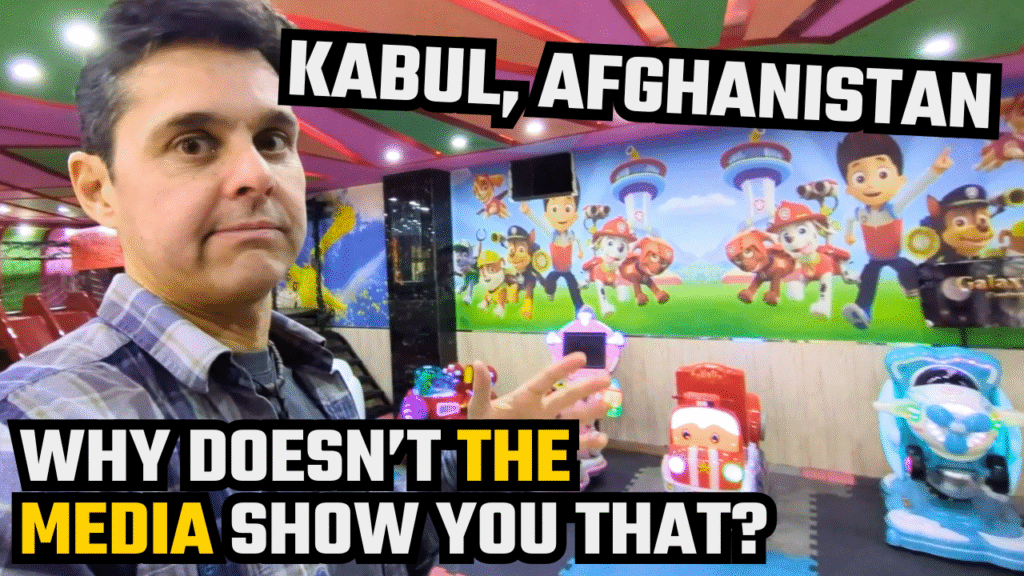
When we think about traveling to Afghanistan, most people’s minds are immediately flooded with images of destruction, endless conflicts, and a landscape of complete isolation. If you follow major international news outlets like CNN or the BBC, the narrative is almost always the same. However, deciding to cross this border and experience the reality firsthand reveals that geopolitics and everyday life on the streets have nuances that television simply chooses to ignore.
Kabul, the country’s capital, is a complex city, full of contrasts and deeply marked by recent history. But contrary to what many imagine, it is also home to a vibrant daily routine, modern cafes, shopping malls, and a population trying to move forward. If you are curious about tourism in extreme destinations or want to understand what is truly happening there today, get ready to challenge your preconceptions.
Or watch my full Kabul video:
First Impressions: Arriving in Kabul and the Reality of the Walls
Landing at Kabul International Airport is the first reality check. Right at the exit, the presence of old military base structures and the iconic heavy concrete barriers—the so-called t-walls—make it clear that this was once one of the most fortified cities in the world. During the years of US and NATO occupation, every major building, whether an embassy, an NGO, or a government agency, required severe layers of protection against attacks.
Today, these giant walls and sandbags remain scattered across the urban landscape. However, the current atmosphere is one of an intriguing calm. A geopolitical curiosity that stands out right outside the airport is the presence of a “Chinatown.” With the departure of the United States, China and other neighboring countries, such as the United Arab Emirates, Qatar, and Saudi Arabia, began investing heavily in local infrastructure, eyeing the country’s mineral resources. Afghanistan, historically known as the “Graveyard of Empires,” remains a strategic pawn on the global chessboard.
Where to Stay? Discovering the Country’s Only Hostel
For backpacker-style travelers, accommodation in Kabul holds a unique surprise: the Afghan Guest House, currently the first and only functioning hostel in Afghanistan.
The atmosphere at the hostel blends traditional Afghan hospitality with the classic vibe of backpackers from all over the world. At the reception, the flags clearly illustrate the local political transition: the new white flag of the Islamic Emirate (as the Taliban government calls the country) flies alongside international symbols. Although the old tricolor flag (green, red, and black) is still seen at airports and sports delegations abroad, the flag of the new regime dominates the capital’s streets.
The breakfast at the hostel is a show of its own and an excellent introduction to the local cuisine. Expect to find tables laden with fresh pomegranates, eggs, sesame sweets, and the famous samosas (fried pastries stuffed with delicious spices).
Starbucks-Style Cafes and Fast Food: The Hidden Afghanistan
If you think that in Kabul you can only eat street food in traditional bazaars, know that the local elite lives a very different reality. In our exploration of the capital’s most modern areas, we found cafes that perfectly resemble major Western chains like Starbucks. The look is identical: young people chatting, drinking iced coffee, display cases full of beautifully decorated cakes, and refrigerators stocked with energy drinks like Red Bull and Monster.
We also went to a Westernized fast-food restaurant, Barg Continental, located in a small shopping center that even displays signs of famous brands (although some franchises are deactivated). In these more sophisticated venues, life seems to run just like in any other metropolis in the world, whether in São Paulo or New York. Burgers, pizzas, and french fries are on the menu and attract Kabul’s upper-middle class, including bankers and construction executives. For this transactional segment of the population, business and lifestyle carry on regardless of who is in power.
Safety Tips and Local Rules for Travelers
Traveling through Afghanistan requires a level of attention and planning much higher than a conventional destination. If you are thinking of adding this country to your itinerary of exotic destinations, here are some essential practical tips:
- Documentation and Visa: The visa issuance process has changed recently. Currently, the new visas are issued with texts predominantly in Pashto (one of the official languages and the one used mostly by the current government), which can cause some confusion or suspicion with airlines when boarding in neighboring countries like Pakistan. Make sure to validate all documentation in advance.
- Dress Code and Nuances for Foreigners: Dress codes are strict, but there are important nuances. Local women must completely cover their hair. However, for foreign women, there is a visibly higher level of tolerance. In private settings or elite restaurants in the capital, it is even possible to remove the veil (hijab). Despite this, in public spaces and religious sites, respect for the culture is mandatory. Wearing the veil and avoiding leaving bangs or hair too exposed prevents unnecessary approaches from religious guards.
- Interaction with Authorities: Police presence on the streets is heavy, made up of members of the Taliban themselves armed with Kalashnikov and AR-15 rifles. Although the image is intimidating at first glance, the current government is highly interested in promoting security to attract tourism dollars. If you face any issues with theft or safety on the streets, the guidance from the locals themselves is to go straight to the police.
Relics and History: The British Cemetery and the National Museum
Afghanistan’s history is told through its scars. In the heart of Kabul, the British Cemetery functions as an international memorial. Walking through it means understanding the weight of past foreign interventions: there are graves and plaques honoring British, Canadian, French, and Spanish soldiers who lost their lives in past missions. Interestingly, the new government has kept these memorials intact, showing an uncommon historical respect between combatants.
Another mandatory stop is the National Museum of Afghanistan. In the 1990s, during the civil war, the building was completely destroyed, turning into an empty structure without a roof. Starting in 2002, through international development funds and investments from countries like Japan and the United States, the museum was fully rebuilt. It is the kind of positive legacy of the occupation that rarely gets highlighted in traditional media.
In the museum gardens, the social contrast is evident. In the recent past, the space was frequented by families and women who could dance and have fun freely. Today, under the new regime, the place remains almost entirely empty, frequented mostly by men, with rare exceptions open to foreign female visitors due to the differing rules.
Conclusion: A Destination Made of Shades of Gray
Traveling through Kabul teaches us that the real world is not drawn in black and white. There are extremely complex and restrictive aspects, especially regarding the rights of local women and individual freedoms. On the other hand, there is a functional urban infrastructure, an active commercial scene, and a people who are extremely welcoming to the few tourists who venture there.
Getting to know Afghanistan up close means going beyond the alarmist TV headlines to discover that, even in the most unlikely places, life pulses and seeks its own paths to normalcy.