
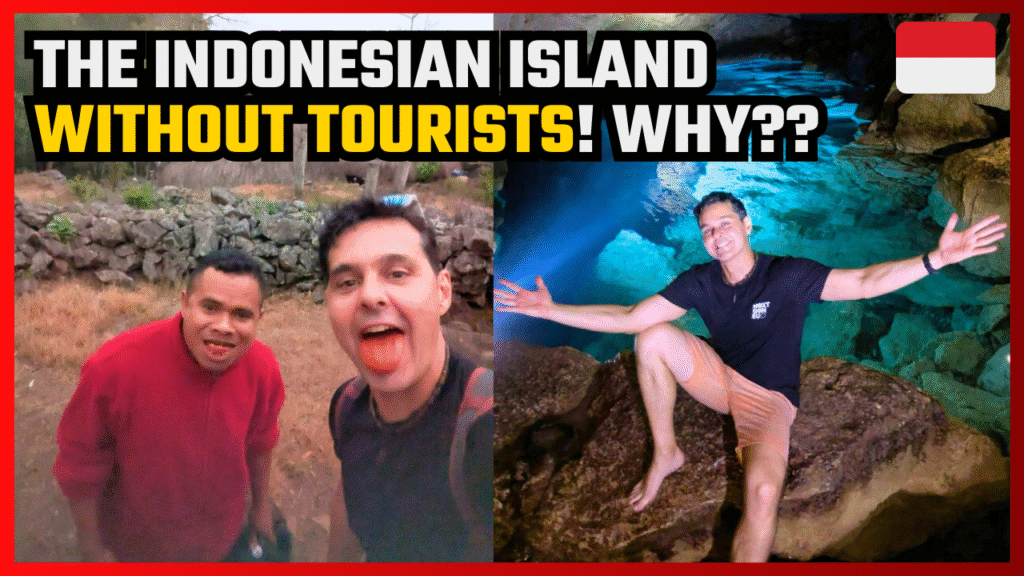
If you’re anything like me, you’re always on the hunt for that “undiscovered” spot—the place where the locals still look at you with genuine curiosity rather than tourist fatigue. After years of backpacking through Southeast Asia, I thought I had seen most of what the region had to offer. Then, I landed in West Timor, Indonesia, and everything changed.
While most travelers flock to the white sands of Bali or the rugged peaks of Lombok, West Timor remains a hidden gem, tucked away on the western half of the Timor Island. It’s a place where massive stone crosses dominate the landscape, crystal-clear lakes hide inside dark caves, and ancient kingdoms still follow traditions that predate modern history.
In this guide, I’ll take you through my personal journey across this forgotten island—from the bustling streets of Kupang to the high-altitude traditional villages of Kefamenanu—and show you why West Timor should be your next big adventure.
Or watch my full video about West Timor:
Arriving in Kupang: Breaking Preconceptions
My journey began with a flight from Bali to Kupang, the capital of West Timor. To be honest, I arrived with a few preconceptions. I expected a tiny, humid jungle airport with minimal infrastructure. I couldn’t have been more wrong.
The El Tari Airport is surprisingly modern, with air conditioning and jet bridges. It’s the perfect jumping-off point for exploring the island. One of the first things I noticed upon landing were Australians with surfboards. Apparently, West Timor has some secret surf spots that the veterans are very protective of! If you’re a surfer, it might take some Google sleuthing to find the exact locations, but the waves are definitely there.
The Realities of Transport: A Lesson in Budgeting
One of my first “fails” in Kupang was underestimating the cost of transport. Coming from other parts of Indonesia, I expected Grab (the local Uber) to be dirt cheap. However, a car from the airport to the city center was quoted at about $15—which is quite steep for Southeast Asian standards.
Travel Tip: If you want to save money, walk a few minutes outside the airport gates. You can usually find a Grab motorcycle (ojek) for a fraction of the price.
I eventually settled into a simple hotel in the city center for about $9 a night. While you can find “rooms” for as low as $3 or $4, I recommend spending a bit more for air conditioning. West Timor is hot, especially between April and May.
Exploring the Crystal Cave: A Hidden Underground Oasis
If there is one “must-see” attraction in Kupang, it is the Crystal Cave (Goa Kristal). I rented a scooter for about $7 (100,000 Indonesian Rupiah) for 24 hours—a bargain for the freedom it provides.
The cave is located on the outskirts of the city and lacks major tourist infrastructure, which is exactly what makes it so cool. When I arrived, a local boy offered to be my guide. You definitely need one; the descent is slippery, pitch black, and a bit sketchy.
Once you reach the bottom, you’re rewarded with one of the most beautiful natural sights I’ve ever seen: a subterranean lake with water so clear it looks like liquid diamond. Swimming in that cool, refreshing water after the humid ride was pure bliss.
Expert Tip: Arrive before 5:00 PM. The natural light that filters through the cave opening creates a magical glow on the water. Also, don’t forget to tip the local guides who provide flashlights and help you navigate the slippery rocks.
The Heartbeat of West Timor: Saturday Night in Kupang
Saturday night in Kupang is an experience in itself. I rode my scooter down to the waterfront pier, which I’ve dubbed the “beating heart” of the city. The atmosphere was electric—families chilling, music pumping from colorful modified cars, and locals gathering to watch the sunset.
What struck me most was the hospitality. Unlike the more touristy islands, people here approach you just to say hello and practice their English. I met Susan, Melissa, and a group of football fans who were thrilled to meet someone from Brazil. In West Timor, you aren’t just another wallet; you’re a guest.
Heading North: The Journey to Kefamenanu (Kefa)
After exploring Kupang, I took a long-distance bus north toward the border of East Timor. My destination was a town called Kefamenanu, or “Kefa” as the locals call it.
The bus ride was an adventure in its own right. My ticket cost a few dollars and even included a meal box with a chocolate roll, bread, and water. The landscape shifted from coastal plains to lush green rice fields and mountainous terrain.
One thing you’ll notice in West Timor is the presence of three massive crosses on many hillsides. While Indonesia is the world’s most populous Muslim nation, West Timor is predominantly Catholic, a legacy of Portuguese and Dutch colonial history. These religious symbols are everywhere and provide a unique cultural backdrop to the journey.
Meeting the King: An Ancient Kingdom in the Clouds
The highlight of my entire trip happened in Kefa. I met a local English teacher named Jack, who offered to take me to a traditional village belonging to the Bibboki Kingdom.
This wasn’t a tourist trap where people put on costumes for photos. This was an actual ancient kingdom located at one of the highest points of Timor Island. We rode through rough, unpaved roads and eventually had to hike because the terrain was too steep for the motorcycle.
Traditional Protocol and the Betel Nut
When we arrived, Jack explained that we had to meet the King and offer a small gift (a “heart opening” offering) to be welcomed. We entered a traditional circular house with a high thatched roof.
Meeting the King was a privilege I didn’t take lightly. As part of the welcome ceremony, I was invited to chew Sirih Pinang (Betel Nut). It’s a mixture of a nut, a leaf, and a lime powder that turns your saliva bright red and has a mild stimulant effect. It makes your mouth feel a bit numb and powdery, but it’s a vital part of social bonding in Timor.
The King expressed his happiness that someone from as far away as Brazil would travel so far to visit his village. It was a humbling moment that reminded me why I travel: to connect with people whose lives are vastly different from mine, yet shared through mutual respect.
Education and Connection: A Spontaneous School Visit
Before I left Kefa to cross the border into East Timor, Jack invited me to his school, SMK Clarence, to speak with his students. This was entirely unplanned, but it turned out to be one of the most rewarding parts of my trip.
The students were shy but eager to practice their English. We talked about Brazil, football, and the importance of learning a second language. For these kids, meeting a foreigner is a rare occurrence, and being able to motivate them to see the world was an incredible honor.
Practical Tips for Traveling West Timor
If you’re ready to pack your bags for West Timor, here are a few things you should know:
- Transport is Informal: Renting a scooter is your best bet for local exploration. For long distances, use the “Bemos” (minibuses) or the larger long-haul buses.
- Language Barrier: English is not widely spoken outside of Kupang and the younger generation. Download Google Translate for offline use.
- Booking Hotels: Websites like Booking.com have very few listings in towns like Kefa. You might need to use local sites or simply show up and ask around.
- Cash is King: ATMs are available in Kupang and Kefa, but always carry enough cash (Indonesian Rupiah) for smaller villages and markets.
- Respect the Culture: West Timor is conservative and religious. Dress modestly, especially when visiting churches or traditional villages.
Final Thoughts: Is West Timor Worth It?
Absolutely. West Timor is raw, honest, and beautiful. It challenges your comfort zone but rewards you with experiences that you simply cannot buy in a luxury resort. Whether you’re swimming in the Crystal Cave, sharing a betel nut with a King, or talking football with students, you’ll find that the “forgotten island” is actually the most memorable place in Indonesia.
So, skip the Bali crowds this year. Head east, cross the mountains, and discover the magic of West Timor. You won’t regret it.