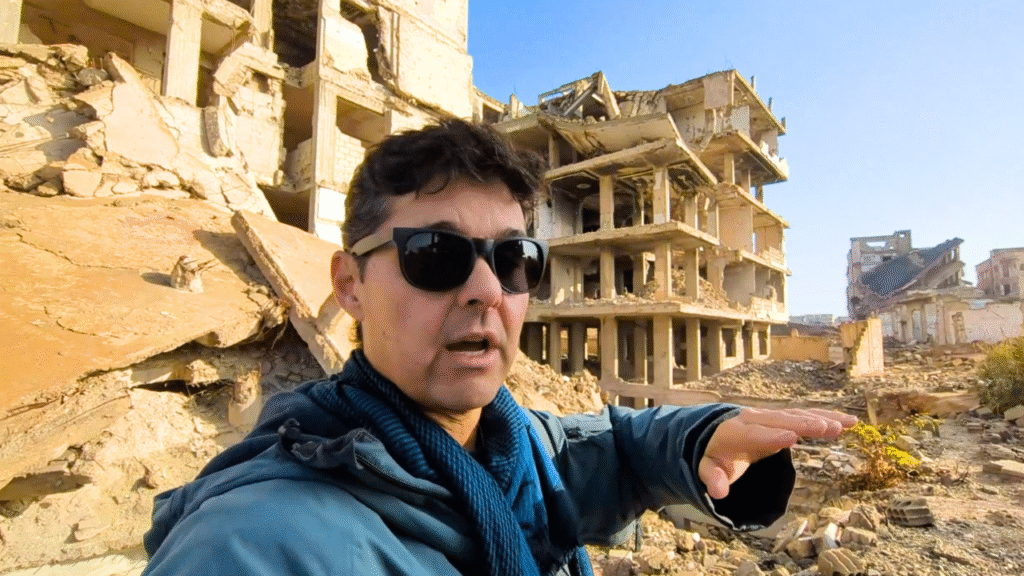
When we think about traveling to Syria, most people’s minds are immediately transported to the images of destruction that dominated the news headlines for years. And if there is one place that embodies this destruction in an almost unbelievable way, that place is Jobar. Located on the outskirts of Damascus, right next to the capital’s historic center, this neighborhood was one of the main battlegrounds of the Syrian Civil War.
I decided to walk through its streets to see firsthand what was left and to understand the true scale of this conflict. The landscape I encountered looks like something straight out of a post-apocalyptic Hollywood movie, with the painful difference that everything here is real. However, tourism in Syria is changing rapidly. Contrary to what traditional media focuses on, the country is going through a surprising phase of transition and reconstruction. If you are curious about traveling to extreme destinations or want to understand the complexity of one of the Middle East’s most intriguing countries, get ready to face raw reality.
Or watch my full adventure in Jobar:
The Heart of the Conflict: Why Was Jobar So Heavily Pulverized?
To understand Jobar’s current state, it is necessary to dive into recent history and regional geopolitics. During the civil war, this neighborhood turned into an extremely fortified rebel stronghold, made highly strategic by its proximity to central Damascus. Rebel fighters chose to resist until the very end, refusing the evacuation and safe-passage agreements that took place in other provinces.
The response from the Syrian regime, heavily backed by the Russian air force, was a massive and relentless bombardment that lasted for years, culminating in heavy operations around 2017 and 2018. Since the rebels lacked robust anti-aircraft defenses, the Russian air force held total control of the skies, resulting in the complete pulverization of the local infrastructure.
Walking through Jobar today means observing the aftermath of high-intensity urban warfare. Entire residential buildings were brought down, the sewage system was destroyed, and even sacred sites were devastated. One of the most striking symbols of this destruction is the neighborhood’s main mosque, whose minaret collapsed completely, leaving only fragments of the structure and its twisted metal peak resting on the ground.
Amid Rubble and Peril: The Hidden Challenges of Reconstruction
One of the most frequent questions I get is: why does a neighborhood located so close to central Damascus remain virtually untouched since the end of the fighting? The answer involves a silent and deadly danger: landmines, booby traps, and unexploded ordnance (UXO).
Although the country has undergone drastic political shifts and a recent liberation following lightning offensives that reshaped territorial control, the deep clearing of areas like Jobar moves very slowly. The accumulated rubble inside the collapsed buildings hides dangerous military artifacts. During my walk, the golden rule was to stay strictly on the asphalt of the main streets, which have been cleared for vehicle traffic. Stepping off the cleared path and into the skeletons of the buildings is an immense risk.
On several corners, you can still spot remnants of combat, such as metal links used for heavy machine-gun ammunition belts. There are also reports of local kids offering to guide tourists through a massive network of underground tunnels built by the rebels to escape Russian bombings. Here is a warning: never accept this kind of offer. Entering these tunnels without military sweeping or professional metal detectors is completely reckless.
Signs of Hope: The Role of International Agencies and Returning Residents
Despite the heavy visual toll of the destruction, Jobar is beginning to show its first, faint signs of life returning. The detail that caught my attention the most was the presence of brand-new, shiny garage doors with no bullet marks, installed on buildings that are otherwise completely riddled with gunfire. This shows that former residents are slowly coming back to reclaim their properties and start using the underground garages—which once served as bomb shelters—to store materials and kickstart a new life.
Another point of massive impact is the work of humanitarian organizations. Amid the ruins, a brand-new UNICEF warehouse stands out, recently painted and completely untouched by bullets. The contrast is stark: a flawless structure surrounded by rubble. The United Nations’ work in Syria is fundamental in rebuilding schools and distributing educational materials to children. It is the kind of direct humanitarian aid that transforms the reality of the world’s most oppressed communities, restoring a bit of dignity and routine to those who lost everything.
Practical Guide and Tips for Traveling to Syria Today
If your adventurous spirit is inspired to experience Syria beyond the stereotypes, know that the journey is entirely doable, but it requires an old-school style of planning. Below, I have compiled the main tips for structuring your itinerary through the country:
- Disconnect from Modern Conveniences: Forget convenience apps. In Syria, you will not be able to book hotels through Booking.com, buy transport tickets online, or call an Uber. All accommodation and travel planning must be done directly with local agencies, authorized guides, or over the counter at properties.
- Safety and Logistics: While places like Jobar hold structural hazards and hidden explosives, the established urban areas of Damascus and the main highways are surprisingly safe and heavily patrolled. The sense of security when walking through commercial and historical zones is very high, defying the expectations of most Western travelers.
- The Metal Economy: Right after the ceasefire, one of the population’s first reactions was to collect all valuable metal left in the streets, such as spent rifle casings and grenade shrapnel, to sell to recycling cooperatives. Because of this, you will hardly find these war souvenirs lying on the cleared asphalt. The informal economy and cash transactions dominate local commerce.
The Striking Contrast: The New Syria Beyond the Destruction
It is crucial to emphasize that Syria is not defined solely by the tragedy and ruins of Jobar. The country possesses a fantastic cultural and landscape diversity that deserves to be explored. Just a short distance from the destroyed neighborhood, life in Damascus pulses with normalcy, packed traditional markets, restaurants, and an infectious energy.
Cities like Aleppo, the country’s second-largest, feature a marvelous medieval citadel that has hosted major celebrations of reconstruction and historic milestones, with street parties resembling carnival or World Cup finals. For travelers seeking coastal landscapes and a progressive, liberal atmosphere, the coastal region of Latakia is a vibrant refuge, while also serving as a strategic hub with a heavy presence of Russian military bases. On the opposite end, the province of Idlib preserves a deeply traditional and conservative environment.
Each piece of this country reveals a different facet of a population trying to rebuild itself after years of isolation. Traveling to Syria is a living lesson in geopolitics, history, and human resilience.