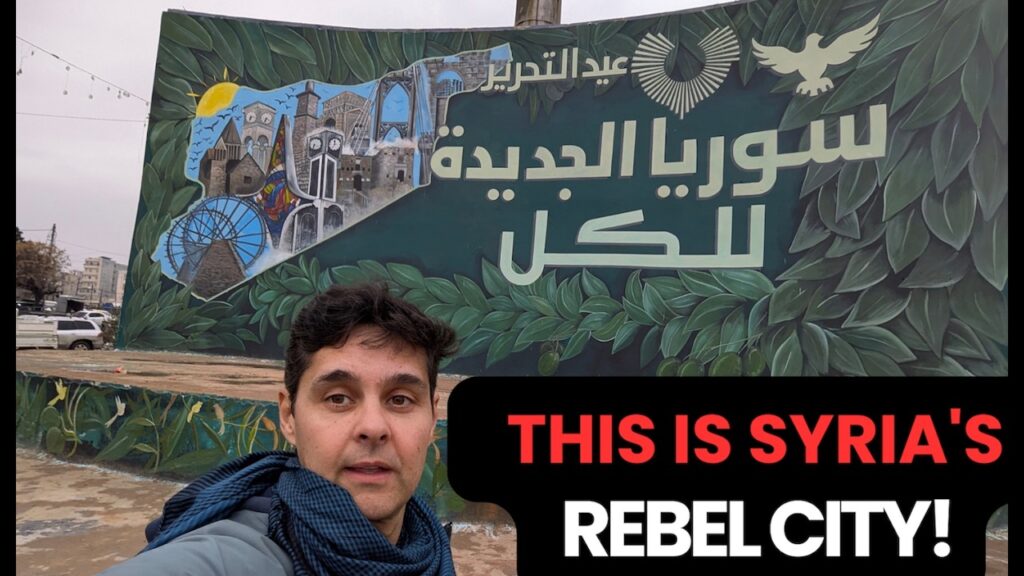
If you follow my adventures around the world, you know that my motto is to step out of your comfort zone. But I’ll be honest: visiting Idlib, in northwestern Syria, tested all my limits. If Kandahar is the birthplace of the Taliban in Afghanistan, Idlib is its Syrian equivalent. It is the most conservative, tense, and politically complex place I have ever set foot in.
In this article, I’m taking you with me on a journey that blends geopolitics, adrenaline, and a profound cultural shock. We’ll explore everything from destroyed roads to illegal arms markets, passing through divine desserts and the omnipresent Turkish influence. Get ready, because entering Idlib is like entering a post-apocalyptic setting where the future is still being written in bullets.
Or watch my full video about Idlib:
The Path to the “Emirate”: From Aleppo to Idlib
Our journey began in Aleppo, a city that, despite its scars, breathes a greater openness, with Christian, Kurdish, and Armenian communities living together. However, as we crossed the invisible border toward the Idlib province, the scenery changed drastically.
Idlib was controlled by fundamentalist rebels for 15 years. They created a near “mini Islamic Emirate” there. About a year ago, these same groups expanded their reach and toppled Bashar al-Assad’s government in just two weeks. Today, although they control the entire country, Idlib remains their most radical bastion.
War Landscapes and Strategic Points
On the way, we passed through Ariha. The destruction there is absolute. Pulverized buildings and artillery marks on every inch of concrete. It’s bizarre to find machine gun ammunition belts lying on the ground a year after the official end of the fighting.
A curious tactical detail: combatants used to seal building windows with concrete, leaving only a small hole for snipers. They also cut holes in internal walls to move between apartments without exposing themselves to enemy fire in the streets. It’s the kind of detail you only truly understand when you are on the ground.
Life in Idlib: Where the Gaze Weighs Heavy
Entering Idlib city itself brings a different kind of tension than anything I felt in Afghanistan. There, the Taliban wanted tourists and made a point of protecting us. Here, it feels like “no man’s land.” The city is full of foreign fighters—Chechens, Pakistanis, Iraqis—and you never know if the guy next to you is a moderate or an Al-Qaeda extremist.
Cultural Shock and Women
For Nick (my partner) and Lotus (our Syrian friend), the experience was heavy. In Aleppo, many women do not wear the hijab and no one cares. In Idlib, we were the only uncovered women we saw. The judgment was palpable.
We were even approached by a boy of about 17 demanding they cover their hair. Lotus’s father promptly put him in his place: “Who are you to say that? You’re not security!” Although there is no formal dress law in the country, social control in Idlib is suffocating. It’s a place where men feel they have the right to dictate what a woman wears.
Geopolitics in Practice: A “Mini Turkey” Inside Syria
Something that surprised me was the massive influence of Turkey. Today, Idlib functions almost as an extension of Turkish territory.
- Currency: They don’t use the Syrian pound; they use the Turkish Lira. To buy a falafel, you need Turkish banknotes.
- Economy: The malls are modern and full of Turkish brands. From carpets to televisions, everything comes from the border next door.
- Military: There are Turkish military bases inside Syria, with communication antennas and Turkish flags flying high.
This influence is strategic. The more a region uses a country’s currency and consumes its products, the stronger that neighboring country’s political influence becomes over that territory.
Gastronomy Amidst the Chaos: Idlib’s Sweet Side
It’s not all tension. Syrian cuisine remains some of the best in the world, even in the most unlikely places.
We had an epic breakfast: falafel with pomegranate molasses, fresh hummus, and an incredibly strong Arabic coffee (the kind with the grounds at the bottom, similar to Turkish coffee). Four people ate very well for less than 10 dollars.
And I can’t forget to mention the dessert at a famous spot called “The Witch.” We had a cream and pistachio sweet that was, without exaggeration, one of the best things I’ve ever tasted. It’s a surreal contrast: you are in a place where people take down your license plate number out of suspicion, but the food welcomes you like nowhere else.
The Illegal Arms Market and the Reality of Drones
Walking through the streets, we passed shops selling everything: from military uniforms and helmets to rifle magazines. There are even advertisements for illegal weapons for sale written in Arabic and Russian. Idlib is the only place in Syria where this type of trade is wide open.
We also saw military convoys with attack drones. It’s the future of warfare arriving in a country that hasn’t even finished rebuilding. Seeing this technology displayed for the liberation celebrations is a reminder that peace there is still maintained by force.
Practical Tips for the Fearless Traveler
If you have an adventurous spirit and are thinking of exploring border regions or post-conflict zones, here are some essential tips:
- Never go alone: Idlib is a place we would not have visited without our Syrian friends. Having someone who speaks the language and understands the local nuances is the difference between a safe trip and a disaster.
- Respect local culture (even if you disagree): While the choice not to wear a hijab is a right, in places like Idlib, it attracts unwanted attention that can escalate. Sometimes, a traveler’s “common sense” is to blend in to avoid trouble.
- Carry Dollars and Turkish Lira: The Syrian pound is impractical due to inflation (you need a brick of bills for a simple meal). In Idlib, the Turkish Lira is king.
- Be careful with your camera: Filming in Idlib is much more tense than in Aleppo. People are suspicious of foreigners recording, thinking they might be spies or ill-intentioned journalists. Be discreet.
- Self-generated Power: The government power grid is non-existent or failing. Almost everyone uses Chinese solar panels and batteries. If you need to charge your gear, make sure your accommodation has this system.
Conclusion: Is Idlib Worth Visiting?
Visiting Idlib is not “tourism” in the traditional sense. It is an anthropological and geopolitical expedition. It’s about seeing up close how a people try to live under an ultra-conservative regime while the rest of the country tries to modernize.
I left with the feeling that Idlib is still a loose piece in the puzzle of the new Syria. While the current president tries to appear more liberal and progressive to the world (appearing in a suit at the White House), the base in Idlib criticizes him for not being “religious enough.”
Syria is a country of profound contrasts, and Idlib is undoubtedly its most extreme point. It was an intense, sometimes uncomfortable experience, but fundamental to understanding the complexity of this country that fascinates me so much.
Did you enjoy this journey? If you have questions or corrections about what I saw, leave your comment below. Let’s talk in a civilized way, as that’s how we all learn.
And don’t forget: step out of your comfort zone!